Facilities•Equipment
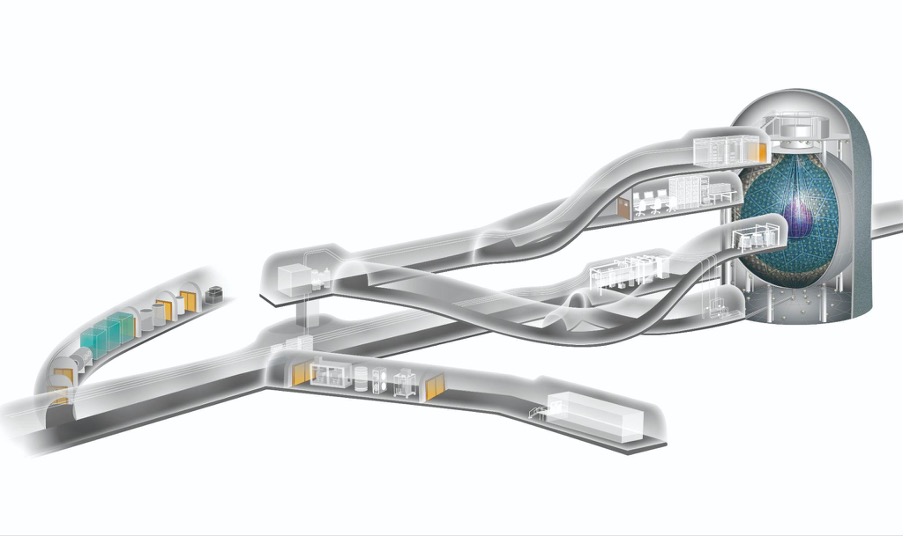
▶ Overview of the Super Clean Facility
The Kamioka Extremely Rare-Phenomena and Neutrino-research Laboratory is located in Tohoku University's underground experimental facility. It features laboratories for collaborative research aimed at fostering the growth of the entire underground particle and nuclear physics community, which searches for extremely rare events in extremely low radioactivity environments. The facility also houses a world-class ISO 14644 Class 1 super clean room, equipped with production systems to supply it with ultra-pure water and pure air. Below is an introduction to the individual facilities and equipment.
Clean Air System
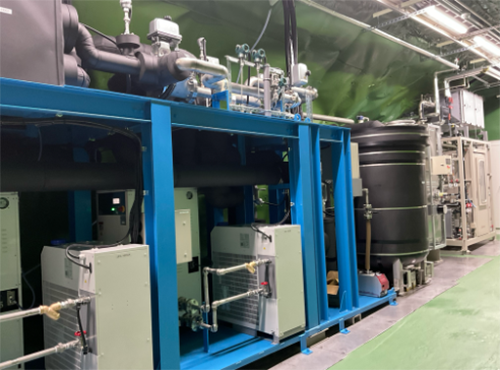
Radon, a radioactive noble gas present in the air, and its progeny isotopes generate severe noise signals that interfere with the observation of extremely rare events. Because radon levels inside the underground tunnels are high, 1,000 m3/h of outdoor air is supplied to various locations within Tohoku University's underground experimental facility. In the KERNEL Machine Room, an ultra-pure air production system processes 200 m3/h of this outdoor air through activated carbon and filters to further remove radon. This pure air can be supplied to both the collaborative laboratories and the super clean room. Furthermore, we are actively developing new technologies to reduce radon concentrations even further.
Pure Water System
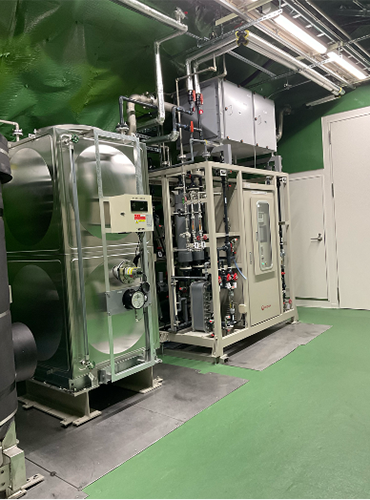
In the Kernel Machine Room, an ultra-pure water production system is installed to produce ultra-pure water (with an electrical resistivity of 18.2 MΩ·cm) using pure water generated by the existing pure water production system. It is capable of supplying up to 2 m3/h of ultra-pure water to the collaborative laboratories and the super clean room. Currently, this system is utilized for cleaning detector components and other equipment to support the KamLAND upgrade project.
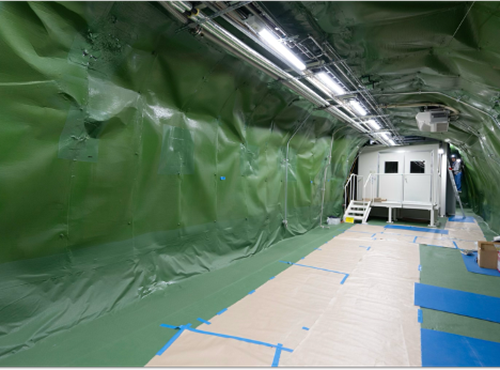
Experimental Space (KERNEL Laboratory)
This experimental space measures 17 m in depth, 6 m in width, and 4.1 m in height, and is located adjacent to the super clean room. It is equipped with supply lines for ultra-pure water, pure air, and nitrogen. Currently, the lab is used for preparing detector components for the KamLAND upgrade. Following the upgrade, it will serve as a collaborative research space for installing analytical instruments aimed at achieving extreamely low radioactivity in detectors for next-generation extreamely rare event searches, as well as for developing and operating prototype detectors to advance detection technologies.
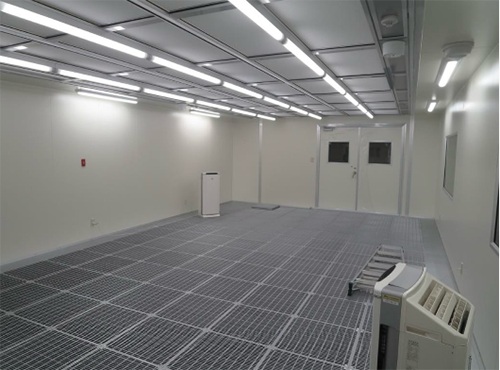
Super Clean Room
This ISO 14644 Class 1 super clean room provides a controlled environment measuring 9.6 m in depth, 4.3 m in width, and 2.4 m in height. Equipped with supply lines for ultra-pure water, pure air, and nitrogen, it is currently utilized for fabricating, cleaning, and packaging detector components for the KamLAND upgrade. Following the completion of the KamLAND upgrade, the clean room will be made available for joint use and research, serving as a facility for research, development, and technological innovation in areas such as crystal growth and high-purity metal refining for next-generation extremely rare event searches.
▶ Clean experimental space
This experimental space measures 5 m in depth, 5.5 m in width, and 3.5 m in height, and supports collaborative research activities for small-scale extremely rare phenomenon search projects. The laboratory is equipped with supply lines for outdoor air and nitrogen gas. In fiscal year 2025, the space hosted the PIKACHU experiment (a double-beta decay search by the University of Tsukuba) and the PICOLON experiment (a dark matter search by Tokushima University). Additionally, a high-purity germanium (HPGe) detector is installed here for collaborative use within the KERNEL facility.
▶ Clean experimental space 2 (CryoLab)
This laboratory houses a dilution refrigerator from WPI-QUP, installed through a collaborative research agreement between the Research Center for Neutrino Science (RCNS) at Tohoku University and the International Center for Quantum-field Measurement Systems for Studies of the Universe and Particles (WPI-QUP). At the Kamioka Extremely Rare-Phenomena and Neutrino-research Laboratory (KERNEL), we have established the Kamioka CryoLab, centered around this dilution refrigerator. A dilution refrigerator is an essential apparatus for creating ultra-low temperature environments below 100 mK, which are indispensable for quantum computers and quantum sensors. With the launch of the Kamioka CryoLab, it is now possible to operate quantum sensors in an environment with extremely low background noise, such as cosmic rays.
By leveraging the extremely low radioactivity technologies of Tohoku University’s RCNS and the advanced quantum sensor technologies of WPI-QUP, we are preparing to advance searches for new extremely rare events, such as light dark matter.
Link URL:
• QUP web
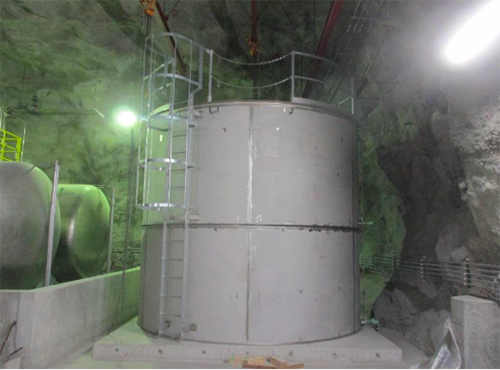
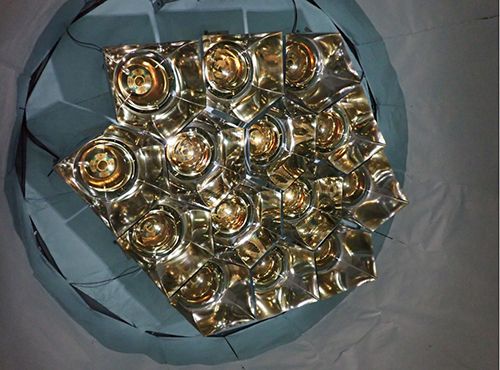
▶ LowBG experimental tank
This 50 m3 cylindrical stainless steel tank, measuring 4 m in diameter and 4 m in height, was used as a testing site for high-performance photomultiplier tubes (PMTs) and light-collecting mirrors aimed at upgrading KamLAND. Following the completion of the KamLAND upgrade, this facility will be available for collaborative use in small-scale projects.
▶ Purification system
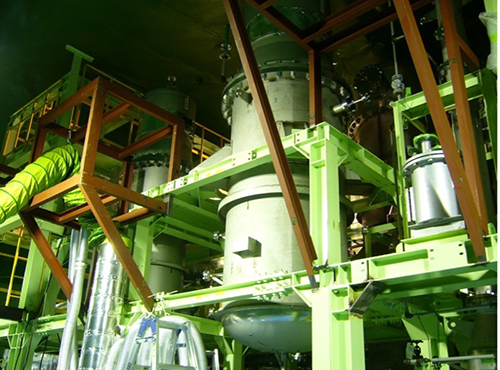
The distillation equipment is installed in a space measuring 23 m in depth, 7 m in width, and 6 m in height. The liquid scintillator used in the KamLAND detector was purified by removing radioactive impurities, such as lead-210 (210Pb), using a distillation method. In this purification system, the liquid scintillator extracted from KamLAND is distilled in order of lowest to highest boiling point—pseudocumene (1,2,4-trimethylbenzene), dodecane, and PPO (a fluor) — while pressure and temperature are carefully monitored to remove impurities. Each purified component is then recombined into the liquid scintillator. Finally, it undergoes nitrogen gas purging to remove radon, a radioactive noble gas emanating from within the purification system itself, before being transferred back into the KamLAND detector.
Currently, preparations are underway to ensure even more stable distillation operations in anticipation of the upcoming KamLAND upgrade.
▶ Xenon system
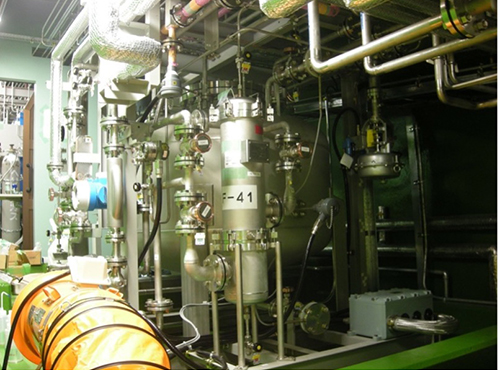
This apparatus is designed for handling enriched xenon-136 gas, which is used in the KamLAND-Zen experiment — a search for neutrinoless double-beta decay. The system is capable of dissolving xenon gas into the liquid scintillator, degassing it, storing the xenon gas, and managing both the supply and retrieval of the xenon-loaded liquid scintillator to and from the KamLAND detector. Additionally, the facility is equipped with gas chromatography for analyzing residual gas concentrations in the liquid scintillator, as well as a high-sensitivity liquid density meter.
▶ KamLAND detector
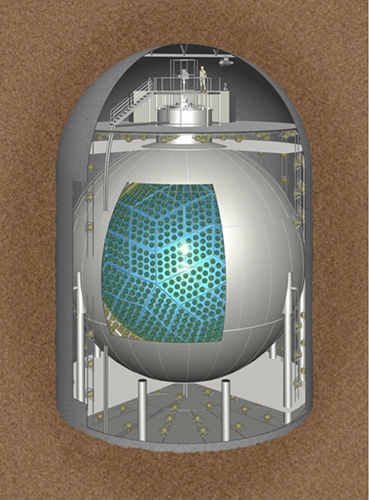
The KamLAND detector is a neutrino observation device utilizing 1,000 tons of ultra-pure liquid scintillator (click here for detailed explanations and research results of KamLAND). It has achieved the world’s lowest-level radioactive environment, with uranium-238 (238U) at 5.0×10⁻¹⁸g and thorium-232 (232Th) at 1.3x10⁻¹⁷g per gram of liquid scintillator. In the KamLAND-Zen experiment, which searched for neutrinoless double-beta decay by introducing a mini-balloon filled with xenon-loaded liquid scintillator into the center of the detector, KamLAND serves as a massive active shield. KERNEL has contributed significantly to achieving this ultra-low radioactivity by maintaining the low-background environment and cleaning detector components for the KamLAND upgrade.